

ORP Grom - First Contact


I really wanted to see her. Descending, I kept my eyes fixed downward, following the line. Trained on Baltic wrecks, I didn't look around - I just watched the line, waiting for a shadow, some shape to emerge from the dark. I glanced at the depth gauge: past 80 metres - I should be seeing something by now. I lifted my head and froze, slowly realising that I had been dropping alongside the starboard hull of ORP Grom for some time already. She was right there, within arm's reach. She surprised me more than any wreck ever had.
She got me on first contact.

1939 and before
Sweden was one of the main suppliers of iron ore to the German war industry. It had started well before the war - in 1902, the Ofotbanen railway opened, connecting the Swedish mines in Kiruna to the port of Narvik. The ore exports ran without interruption, and once war came, they became strategically critical. The ore was carried by rail to Narvik, then shipped south by sea - in winter, hugging the Norwegian coastline, sheltered by Norway's neutrality. For Germany, this route was indispensable. The Allies knew it perfectly well and from early 1940 were looking for ways to cut it. When both sides began planning operations in Norway almost simultaneously, the Germans moved first - on 9 April 1940, Operation Weserübung began.

April 1940
The fighting began on 9 April 1940 with simultaneous invasions of Denmark - which surrendered within hours - and Norway, where resistance continued until the fall of Narvik on 10 June.

The Polish destroyer ORP Grom (destroyers of her type were known at the time as torpedo boat destroyers) took part in the battle for Narvik, as did her sister ship ORP Błyskawica - which still stands today at the quayside in Gdynia. Several Polish vessels operated in the Narvik area: alongside Grom there was Błyskawica, ORP Burza, and below the surface - ORP Wilk and the still-missing ORP Orzeł, last spotted in June 1940 during the very same battle, after which she vanished without a trace. It was Orzeł that tracked and sank a secret German troop transport - the unmarked Rio de Janeiro - on 8 April 1940.

4 May 1940
The Germans had set a trap, positioning shore-based artillery batteries along the fjord. When Grom came within range, the shelling began - and ended with those positions destroyed. The night of 3–4 May, Grom spent watching German troop movements at the entrance to Rombakken fjord.

In the morning, around 08:30, two German aircraft were spotted from the deck and anti-aircraft alert was sounded. A third - a Heinkel He 111 bomber - came in from the direction of the sun and dropped six bombs near the ship. Two found their mark. One detonated near the torpedo launchers, the other hit the starboard side by the funnel. In addition to tearing open nearly 20 metres of hull plating, the explosion ignited the compressed air tanks feeding the torpedo tubes. Grom heeled to starboard, broke apart just aft of the funnel, and sank within three minutes.

What deserves to be remembered: Lieutenant A.L. Krąkowski, who went back below to the engine room - and died there - trying to prevent the boilers from exploding. And an unnamed torpedoman who secured the depth charges, saving the men in the water from being blown apart by their own ship's ordnance. Fifty-nine men were lost. The British ships HMS Aurora, HMS Faulknor, HMS Enterprise and HMS Bedouin came to the rescue, pulling 154 Polish sailors from the fjord.
ORP Grom settled on the bottom at over 100 metres. The stern section landed on its starboard side. The bow section came to rest almost perpendicular to it - as it sank, it flipped keel-up, resting on the bridge structure, leaving the bow pointing unmistakably toward the surface…

August 2010
…and it was along that upturned keel that I descended on my first dive with Grom. A first dive on a wreck like this is usually about observation for me - reading the site, finding the landmarks, marking the places worth returning to. We had five days planned on the wreck. After that first dive, I didn't say much. The image stayed with me - just a hull, a sheet of greenish steel - and yet something was different. That sharp bow too, angled in a way that made no physical sense, and somehow still looked like it was daring you to come closer.
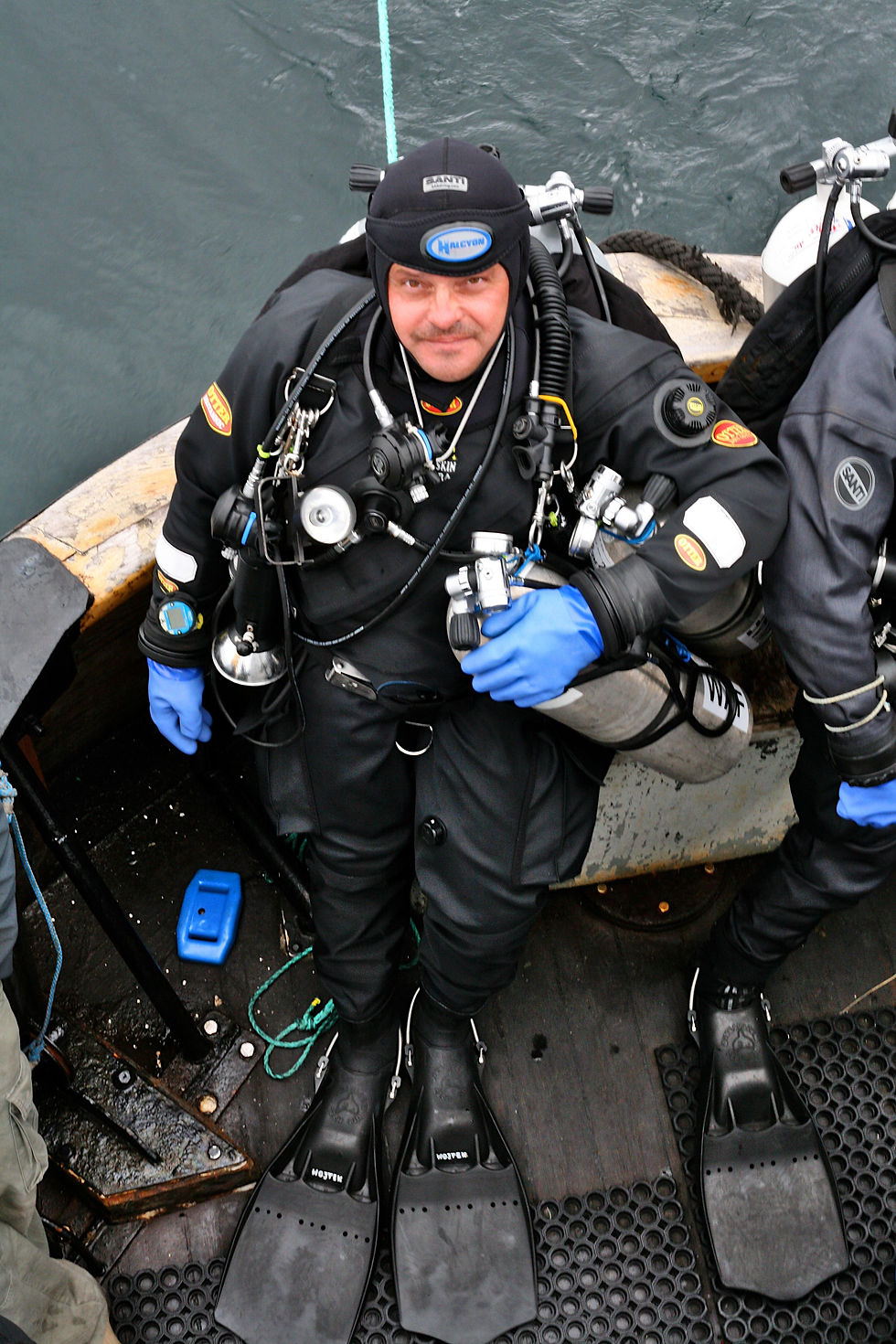
The following dives settled into routine. Tired from the long journey above the Arctic Circle, we fell quickly into the rhythm that a well-run diving project demands - teams rotating, a support team always ready to enter the water while others were below. Sebastian handled the planning and logistics. In the years that followed, I never encountered a diving operation that well organised, involving teams from several different countries.

There were moments that made us smile too. We had planned a shot near Grom's large propellers. The plan was clean enough: one of us lights up the port propeller from above with a wide beam; on signal, the second glides through on a scooter with the lit propellers as backdrop; the third films everything. As you can see in the footage - it didn't go quite like that. That scene where we're apparently having a calm underwater discussion by the props? What you're watching is us trying to salvage a plan that had just completely fallen apart. The shot we got instead turned out better anyway.

The other thing worth mentioning: our cameraman - Sebastian - wasn't supposed to bring a scooter - he was to be towed by another diver. We reached the propellers, I turned around, and from a distance I saw the signal for "heads up." It turned out the scooter meant to tow two divers wasn't up to the job. He had finned the whole way himself, and arrived without any difficulty whatsoever.

There are still many personal effects scattered around the wreck - crew belongings, parts of weapons, small objects that stayed where they fell. I would normally not be able to tear myself away from things like that. But I had already found something that had quietly closed the circle for me. Near the stern, tangled in nets, we found the ship's coat of arms - the stern shield with the Polish eagle.
The water around ORP Grom is cold. But the fjord is extraordinarily clear, and if you look up from beside the wreck, you'll see sunlight reaching down through the green - much deeper than it has any right to.

I could write a much longer piece - covering each dive in detail, the dinners eaten before midnight in daylight that refused to end, the atmosphere in the team. I could. But diving on ORP Grom was the only time in my life I felt like I could feel a wreck. When I think about why, I keep arriving at the same answer:

Grom - this broken destroyer lying in silence at depth - gave me the impression of… combat readiness. A strange thing to feel. I have never felt anything like it on any other wreck, before or since.
In 1979, a monument was erected in Narvik in memory of the Polish sailors who fought for Norway's freedom. In 1990, a commemorative plaque bearing the names of those who died on Grom was unveiled at the local museum. It was funded by one of the survivors - Tadeusz Głowacki.
In memory of Robert Klein

This trip was what it was because of the people who were there. Sebastian Popek, Tymek Podgórczyk, Maciej Rułka, Magnus Lindstrom , Dmitrii Gorski, Michał Linettej, Rafał Pałucha, Robert Klein - thank you for the photos, the footage, and the kind of company that makes a place stay with you.


Comments