

Sea Dog

How to travel by sea with an Australian Cattle Dog

For people, a ferry is one of the calmest ways to travel. I don’t mean the very short crossings, like the many ferries in Norway.
We planned a road trip around Sweden. From Gdańsk we decided to take the ferry to Nynäshamn. The crossing takes 18 hours. The ferry sails at night, so when we wake up, we are almost there.
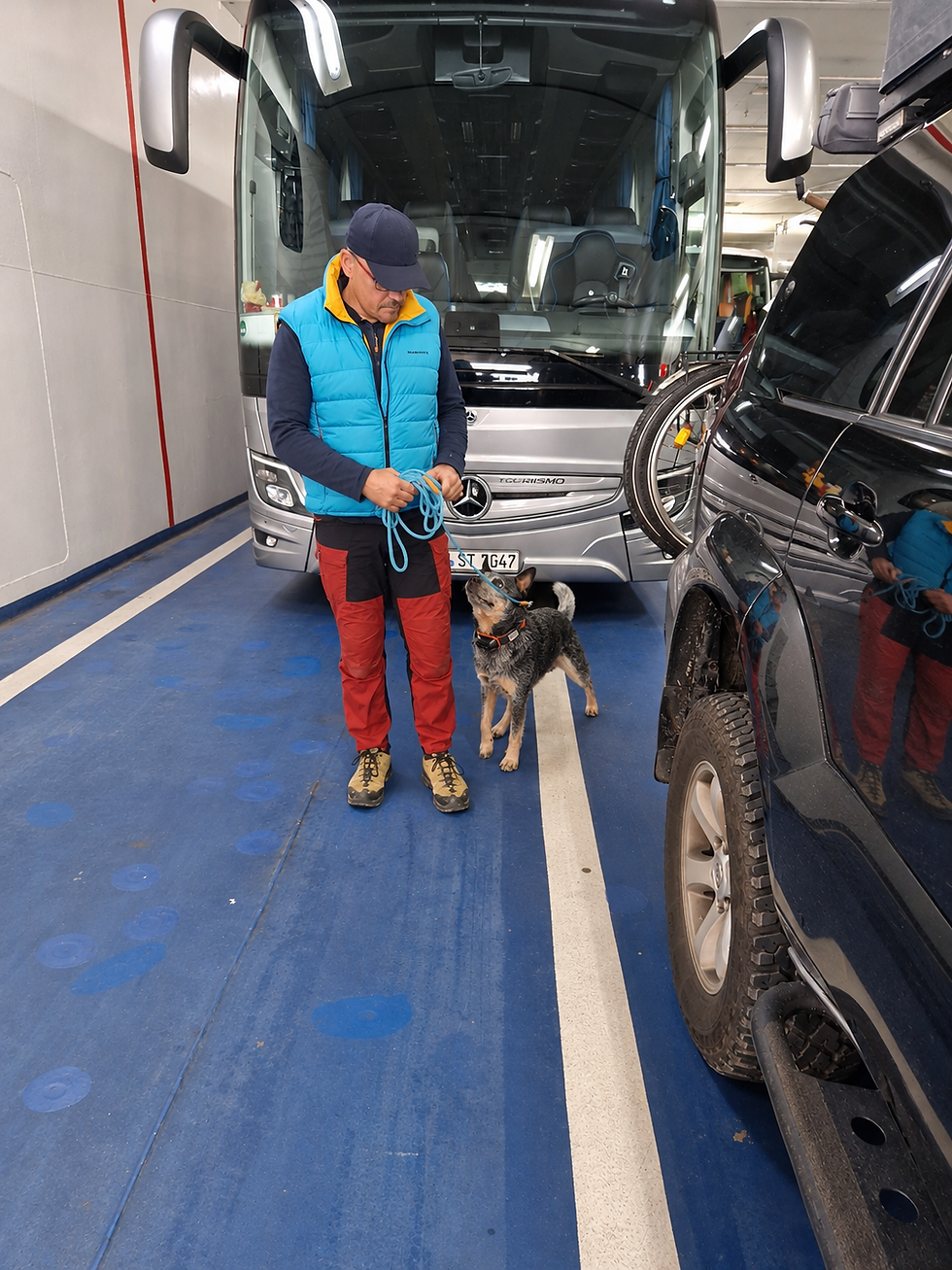
Mrok and the ferry
Until now, the biggest “ship” Mrok had travelled on was a kayak. He did well on the Atlantic during our trip to Portugal. But a ferry is different: more than ten hours on a ship full of people and other animals, a new environment, narrow corridors and unexpected meetings. These were the challenges we set for our human-dog team.
Getting to Gdańsk by car took a few hours. The car is something Mrok has known since he was a puppy, and he fully accepts it. He is still young, but he has already travelled more than 50,000 km with us in our Land Cruiser, as a passenger and a full member of the team.

On board
From the moment we parked on the car deck, everything was different. Cars and buses stood very close to each other. People moved around chaotically and often shouted to each other. And in the middle of all this, dogs were barking.
We had no problems taking a crowded lift to the right deck. Then we moved into our cabin, which had a big window and two beds. Before driving onto the ferry, while we were waiting in the queue of cars, we took Mrok out for a pee and a poo. Only the first one worked. So before we went to bed, I took Mrok to the “dog toilet” area. Pee: yes. Poo: no. The dog toilet was a flat box filled with sand, standing on two euro pallets. The smell of the sand was so strong that almost every dog avoided it and peed on the deck next to it instead.
The night was fine. In the morning we went for a walk on the top deck. It was warm and sunny. We checked what time the doors to the car deck would open, and we went down to our car before the crowds started moving.

Our observations
Mrok was nervous and restless when we passed a small dog that was struggling in its owner’s arms. But overall, we were happy with how he coped. He relaxed in the cabin, and he was fine when we both went to dinner and left him alone. We think his nervousness had more to do with us: we were the ones who felt unsure about the whole situation.

Tips for a long ferry crossing
A pet-friendly cabin is, in our opinion, the best way to travel on a ferry with a dog. With a cabin, you don’t need the other two options: staying with your dog on the public decks with lots of other passengers, or leaving your dog outside in a special kennel. A fourth option that ferry companies accept is to leave the dog in the car on the car deck. There are only a few pet cabins on each ferry, so book early. We booked ours more than six months before the trip.
Most dogs did not want to use the sandbox toilet. I suspect this is because the sand is changed very rarely. The dog toilet is at the stern (the back of the ship).
A long journey can be easier for your dog if you skip the last meal before boarding and, if possible, give your dog a longer walk before the trip.
Instead of two bags of “calming” treats, it is better if you, the owner, are relaxed and calm.

From Poland’s Baltic beaches, you can't watch the sun set over the sea. But move a little further north... and even that little problem can be solved :) Take a walk around the decks without your dog first. Then you can lead your dog through places where you can safely pass other dogs, for example on the way to the toilet.
Getting into the cabins and leaving the ferry are the two most chaotic moments. People rush around, often shout, and sometimes push into the lift with a dog in their arms just to go up one floor. The crew are happy to tell you the best time to leave your cabin, so you avoid crowds on the stairs, in the lifts and on the car decks.
Learn the way from your car to your cabin and back. There are several car decks and several passenger decks. If it is your first time on a ferry, it is easy to get lost. On the way back to the car before driving off, it can be hard to squeeze between cars parked very close together and lots of people.
For a long crossing in a cabin, take only the essentials for you and your dog. Don’t drag a huge suitcase with you 😉

How Mrok’s training helps on journeys like this
On both ferries we took (we write about the second one below), Mrok stayed calm in many situations. What helped?
Walking in crowds. We practised this, and still sometimes do, in the city, in shopping centres and on public transport.
Moving between cars parked close together. This is easy to practise in underground car parks and at shops and shopping centres.
Riding in lifts: first only us and the dog, then gradually with more and more people. Shopping centres and blocks of flats with lifts are good places for this.
Using stairs in narrow stairwells: blocks of flats, stairwells in shopping centres.

Mrok's second ferry trip lasted just under three hours. We spent the whole journey on deck with many other passengers and their dogs. Wearing a muzzle, including a medical muzzle. We always practise this, even when we are not travelling by ferry 😊
Working at low arousal. This means, among other things, being able to ignore another dog and not react to it.
Dealing with separation anxiety. We worked with Mrok so that he can stay alone at home, but also in the car or in a hotel room.
The environment on a ferry can change much of your dog’s usual behaviour. In our opinion, this is not the time for “saying hello” to other dogs or for other experiments. It is better to be careful and do everything to keep your dog as calm as possible for the whole journey.

A short ferry trip from Denmark to Germany
On the way back from our Sweden trip, we visited an interesting place in Denmark. We changed our route home and took the ferry to Rostock in Germany.
This time it was a short crossing of less than three hours, but with... quite a few challenges.
There were more than ten dogs on board, and all of them were on the same deck. We wanted to find a quiet place, but experienced dog travellers had already taken all the corners and quiet spots. The only seats left were in the middle of the deck, the most exposed seats of all.
To our surprise, Mrok stayed calm. He watched the passengers who were watching him.
The real problem was the owner of a white poodle. He decided to walk his dog around every corner of the deck, without caring about other dogs. Mrok started to growl when the poodle, on a tight lead, first barked at the coffee machine and then switched its attention to Mrok. The owner jerked the poodle back on a short lead, and Mrok moved towards the poodle. I calmly asked Mrok to leave it and sit next to me. To my surprise, he did, as if he had been waiting for this kind of help.
The poodle came back a few more times. We always knew where it was, because the other dogs reacted.

Tips for a short ferry crossing
Arrive at check-in as early as possible, so you can be one of the first cars on board. When you park, go up to the passenger deck quickly and find a place where you and your dog can sit quietly.
Don’t walk around. Don’t make life harder for other dogs.
Be ready to act fast. You are in a closed, sometimes cramped space. A “white poodle” may appear. It is a new environment, and you don’t know how your dog will react.
Even if someone is clearly making mistakes, don’t get angry and don’t argue. It will only build tension, and your dog doesn’t need that.
Bring wet wipes, bags or something else to clean up if your dog vomits or has an accident.

How Mrok’s training helps on short crossings
Most helpful of all: travelling on crowded buses and trains, and walking around train stations and platforms.
Self-control: do everything you can not to throw the poodle’s owner overboard, because then you would have to look after the poodle 😉

To sum up
Travel is worth it. It takes the bond between you and your dog to a new level, often one you have never experienced before.
It is also worth thinking ahead. One of the reasons a dog has us is that we can predict what may happen and prevent it.
And above all, enjoy the journey.
Your good mood and calm approach to every situation will help your dog, other dogs and... the owners of white poodles 😉


Comments