

Sniffing Reduces Stress.

Updated: Apr 26

Do you let your dog sniff freely on walks - or do you stop them?
I'm genuinely curious, because one of the more surprising things I've heard since getting a dog is: "he can't, other dogs pee there."
Mrok sniffs as much as he wants. Sometimes he rolls in something that smells spectacularly dead, or tries a mouthful of fresh horse manure - I don't interfere.
Though I should be honest about what "I don't interfere" actually looks like.

One night, in a park with several ponds and a well-established beaver colony, Mrok disappeared into the bushes. Curious, I followed. He came back looking more satisfied than I'd ever seen him - tail up, confident trot.
It turned out he'd found a beaver. A very dead one. Considerably decomposed.
We spent the next few days trying to get the smell out of the car. And out of Mrok. With limited success.
So when I write "I don't have a problem with it" - that's mostly true. I just also carry a very specific memory of what peak canine happiness smells like. And what it cost one unlucky beaver.
When it's curiosity rather than compulsion, I leave him to it. There's something worth watching in how differently - and how similarly - dogs and humans experience the same world through scent.
Worth knowing what's actually in old carrion. Clostridium botulinum - paralyzes. Leptospira - kidneys, liver, gone. The carcass of a poisoned fox or rat still holds the rodenticide that killed it. Dog rolls in it. Licks the coat. Toxin travels.
Mostly nothing happens. A bath, a story for later. But not always. Sometimes it's the vet.
Find out what carrion can do to your dog. Then you decide where the leash gets shorter. He rolls in what you let him.

Why sniffing matters:
A dog that's sniffing is processing a huge amount of information - who passed by, when, and what state they were in emotionally. It's how they read their surroundings, the equivalent of us looking around when we walk into a new place.
It's also one of the main ways a dog regulates its own tension. When the nose is working, the parasympathetic nervous system kicks in - the one responsible for calm and recovery. Heart rate drops. Sniffing settles them.
A dog that's consistently stopped from sniffing doesn't just lose a pleasure. It loses a tool for managing stress. You can see it in the gait, the posture, in how the dog reacts to everything else on the walk.

What about rolling in dead things?
Mrok can roll in the remains of a mouse and come back to me looking like he just won the lottery. Science doesn't have a definitive answer here - there are three theories, each reasonable, none proven.

First: scent masking. Wild canids rolled in carrion to cover their predator scent and get closer to prey - an antelope doesn't panic at the smell of its own dung, so a wolf coated in it had a tactical advantage. Behaviorist Patricia McConnell is skeptical: if prey animals have a nose sharp enough to detect a predator, layering another smell on top probably doesn't fool them (McConnell, The Other End of the Leash, 2002; see also her blog post "Why Do Dogs Roll in Disgusting Stuff?")..
Second: communication. Pat Goodmann, research associate and curator at Wolf Park in Indiana, spent years studying this behaviour. She observed that wolves returning with a new scent on their fur were immediately investigated by the rest of the pack, who would then track the smell back to its source. Rolling may have been a way of telling the group - there's something worth finding out there (Goodmann, Scent Rolling in Wolves, M.A. thesis, Purdue University, 1978).
Third: it just feels good. This one isn't really a scientific theory - no one has measured what's happening in a dog's brain mid-roll. But anyone who's watched a dog do it knows the look. Whatever the evolutionary roots, in a domestic dog this behaviour probably persists for the simplest possible reason: it's enjoyable.
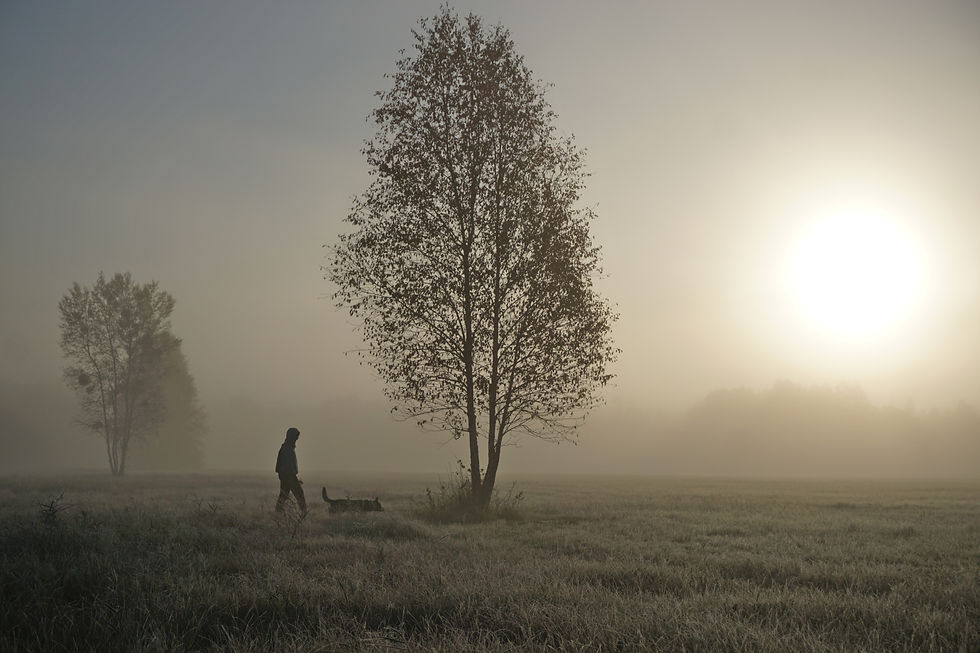
Smell is at the center of a dog's life in a way we tend to underestimate. Whether they're reading it off the ground, carrying it home on their coat, or using it to settle their own nervous system - it's the same sense, doing the same job. And of all the things scent does for a dog, that last one matters most to me as an owner: a dog that gets to use its nose is generally a dog in a better mood.
I'll be honest - I don't fully understand why anyone would stop a dog from sniffing. But I'll give people the benefit of the doubt. There's probably a reason, even if I can't always see it.
So here's a suggestion - treat it as an experiment. Give it one walk. Nose down, no rushing, no redirecting. Think of it as their day off. The whole walk, they sniff whatever they want.
Then compare how they are after that walk with how they are after one where they've been pulled along.

The sources I used - if you're curious:
Duranton, C., & Horowitz, A. (2019). Let me sniff! Nosework induces positive judgment bias in pet dogs. Applied Animal Behaviour Science, 211, 61–66. https://doi.org/10.1016/j.applanim.2018.12.009 Dogs allowed to engage in scent work showed measurably lower stress and more optimistic responses to ambiguous situations.
Fountain, J., Fernandez, E. J., McWhorter, T. J., & Hazel, S. J. (2024). The value of sniffing: A scoping review of scent activities for canines. Applied Animal Behaviour Science, 282, 106485. https://doi.org/10.1016/j.applanim.2024.106485 A PRISMA-guided review of 27 studies on behavioural and physiological changes in dogs during scent-based activities.
McConnell, P. (2015, June 1). Why do dogs roll in disgusting stuff? The Other End of the Leash [Blog]. https://www.patriciamcconnell.com/theotherendoftheleash/why-do-dogs-roll-in-disgusting-stuff A skeptical look at the scent-masking theory — and an honest admission that no one fully knows.
Coren, S. (2009, July 29). Why do dogs roll in garbage, manure, or other smelly stuff? Psychology Today. https://www.psychologytoday.com/us/blog/canine-corner/200907/why-do-dogs-roll-in-garbage-manure-or-other-smelly-stuff An overview of evolutionary theories behind dogs rolling in intense smells.

Read this.
In 2022 researchers at Cornell, using diffusion tensor imaging (DTI) on 23 dogs, documented something not found in any other studied species: five white-matter tracts linking the olfactory bulb directly to the visual cortex. Humans don't have it. Mice don't have it. Dogs do - and thick enough to make up more than one percent of the brain's volume.
That changes everything you thought you knew about a walk.


Comments