

Does the ACD have traits no other dog has?

A text about a breed usually falls into one of two traps. Either it becomes a tribute piece where every trait proves this is the greatest dog in the world. Or it becomes a warning where every trait is a reason not to get the breed (and I don't need to look far, I wrote that warning article about the ACD myself.

You're reading this because the ACD is probably already part of your family. So you won't find a superhero from Australia here, and you won't find another cautionary tale either.
I'm describing a few traits that show up in the Australian Cattle Dog in a form that is either unusual or simply more pronounced than in most dogs. The text will let you get to know these traits in detail, from where they came from, and it may change how you look at your own ACD.

Mrok, our ACD, is twenty-eight months old. He shows up here as one illustration among many. A single dog proves nothing about a breed. Breed documents, selection history, and research prove things. Mrok only shows what these traits look like in one specific dog, at home, on a walk, in a café, and out on trips with us.
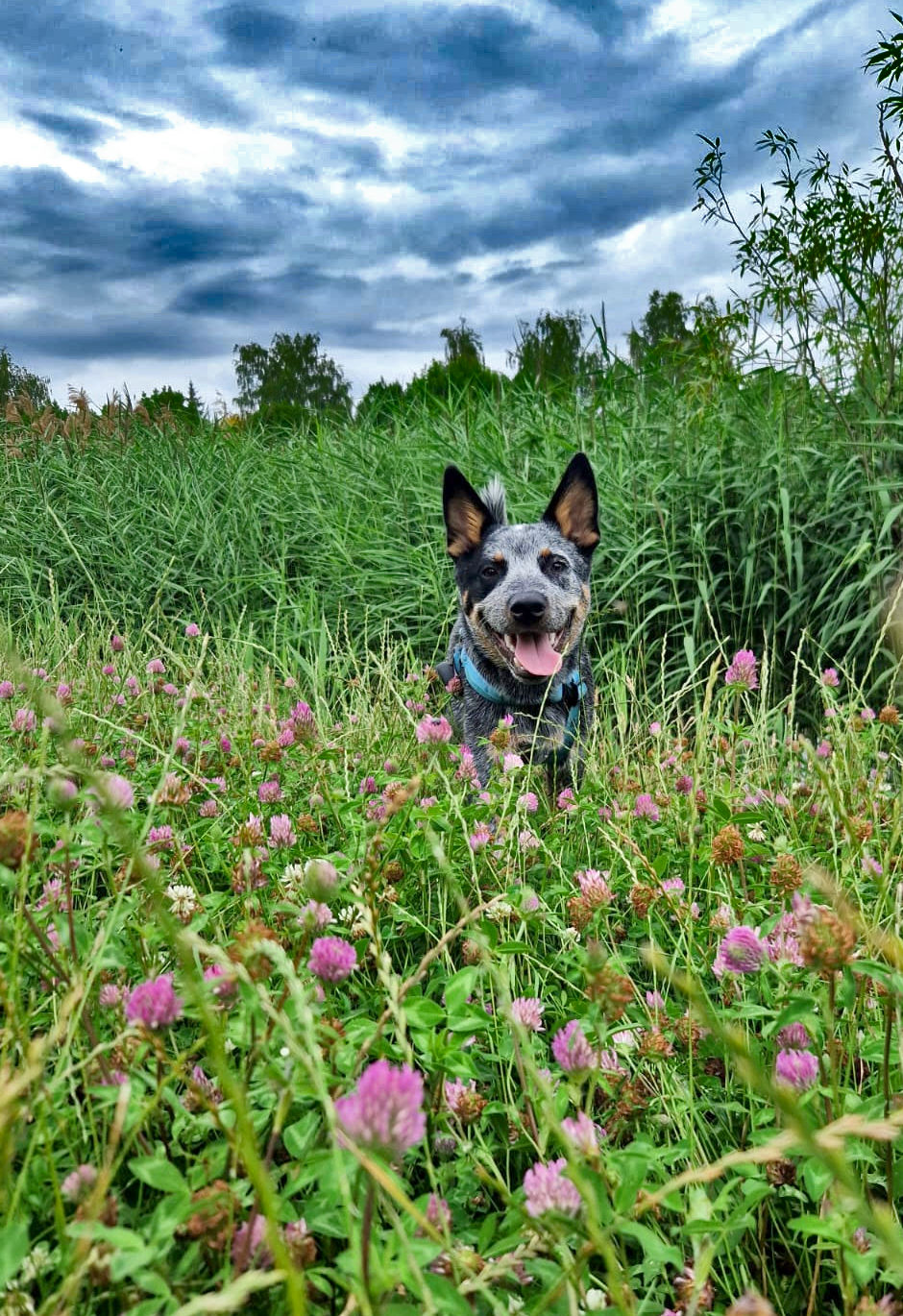
Dingo in the genes. Most herding breeds came from crossing domestic dogs. The Australian Cattle Dog came about differently.
In the 1840s (to keep it simple, around the year 1840) a drover named Thomas Hall needed a dog that could handle the Australian climate and work half-wild cattle on drives that lasted weeks. The herding dogs brought from Britain couldn't do it. They dropped from the heat and scattered the cattle by barking. Hall crossed Highland-type collies with dingoes. The Working Standard of the Australian Cattle Dog Club of America describes it plainly: the cross combined the toughness of the dingo with the herding ability of the collie, reinforced the heel-biting instinct, and removed the barking at the head of the animal.

A dingo is not a feral domestic dog.
It is a separate lineage, isolated from domestic dogs for several thousand years. A genome study by Weeks, Cairns and colleagues, published in Evolution Letters in 2025, found no effective introgression (no real gene flow) between dingoes and domestic dogs, despite two centuries of living side by side on the Australian continent. The dingo is on its own path to becoming a separate form. The Australian Cattle Dog carries a piece of that lineage's DNA.

No other herding breed in the world has this.
The dingo survives in conditions that killed British herding dogs: high temperatures, poor food, long distances over rough ground. Britannica, comparing the dingo and the ACD, points to a shared feature: a dense, weather-resistant coat that helps the animal survive in the harsh Australian climate. What was an adaptation for wild life in the dingo became a working feature in the ACD, the ability to put in a full day under the sun.

Is the ACD mostly dingo?
This is where it gets interesting. I read different recipes for how the ACD was made. Most of them share several common elements, but they also have important differences. Most ACD breeders in Europe build the breed's history their own way, and the breeding goal decides which features they emphasise. Some of these stories live their own life, independent of the Australian sources where the breed actually comes from.

What's interesting is that in the country of the Aboriginal people, there are also two main historical lines.
So I left aside what's available on the websites of our breeders, and I went to Australia, with the intention of taking a trip into the past, to make sense of my present in the world of the ACD.

Australia's import rules are complicated enough that I couldn't get on a plane and show Mrok the place he comes from. So I travelled using the keyboard of my laptop. I got to libraries, archives and kennels in digital form without any problem.
What were all those hours of searching for? Not to argue with the kennel club about the proper tail length of an ACD. To look at the topic a little differently, for myself and maybe for you.

I invite you to read about how 7 clever cows made Mrok.
Below is a timeline with the firm dates, and notes added where the ground is softer.
Year 1623, Cape York Peninsula. The first written European mention of dogs living with Aboriginal people. Dutch navigator Jan Carstenszoon notes the presence of these dogs in the north of the Australian continent, almost a hundred and seventy years before British colonisation. It isn't yet a description of the dingo by name, but it is the first document of the existence of the animal that would later become one of the parents of the ACD.

Year 1788, Sydney Cove. Arthur Phillip's First Fleet unloads at Port Jackson the first seven head of cattle in Australia: two bulls and five Cape cows (black, South African stock). This is the absolute beginning of cattle farming on the continent.
Four months later, in June 1788, the entire herd escapes into the bush and disappears. The colony loses its only source of cattle, which for the young settlement counts as a disaster.

Year 1789, Port Jackson. Watkin Tench, a British marine officer, publishes A Narrative of the Expedition to Botany Bay. In this book the word "dingo" appears for the first time in European writing, spelled phonetically from Dharug, the language used by Aboriginal people around Sydney. Tench writes that "the only domestic animal they have is the dog, which in their language is called Dingo, and a good deal resembles the fox dog of England." Four years later, in 1793, Friedrich Meyer, based on the description and drawing by Governor Phillip, classifies the animal as Canis dingo. From this moment, the dingo is in European science.

Year 1790,
Newcastle upon Tyne. Thomas Bewick publishes A General History of Quadrupeds, an encyclopedia of mammals with woodcuts of his own making. In the book he describes a herding dog called the "Cur," used in northern England to work cattle. Bewick writes that the Cur "bites very keenly, and as they always make their attack at the heels, the cattle have no defence against them," and that many individuals are born with short tails, as if they had been cut. This is a description of a dog that would fall out of use and die out as a type by the middle of the 19th century, when the railway replaced long-distance cattle drives to the cities. Whether this particular dog made it into the ACD is an open question that I'll come back to in a moment.

Year 1795, Nepean River. 7 years after the great escape, the cattle thought lost are found south of the Nepean River, a hundred kilometres from Sydney. After seven years in the bush, seven head had turned into a herd of more than a hundred living wild. By 1801 the count is between five and six hundred. By 1804, between three and five thousand. The area is named the Cowpastures. This is where Australian cattle farming is born, and with it a very specific problem. On the Australian continent, herding dogs from the British Isles are not enough. Cattle raised in the wild are skittish, fast, and aggressive. Herding dogs imported from England and Scotland can't handle them in the heat, on long distances, on rough terrain. This gap will be the main reason why Hall, thirty years later, starts crossing herding dogs with dingoes.

Year 1802, Hawkesbury, New South Wales. George Hall, a free settler from Northumberland, arrives in Australia with his wife and four children on the ship Coromandel. He sets up a cattle operation. One of his sons is Thomas Simpson Hall, born in the Hawkesbury in 1808.

1830s and 1840s, Dartbrook Station, Hunter Valley. Thomas Simpson Hall, George's son, runs his own breeding program. He imports Durham cattle from family back in England. Not satisfied with the herding dogs available in the colony, he crosses working dogs with dingoes that he keeps in captivity. According to family records, the program stabilises around 1840. The result is a type of dog named Hall's Heeler, the first native Australian working dog.
This is where the first big question mark appears.
Question one: which herding dog did Hall use?

The Working Standard of the Australian Cattle Dog Club of America, the FCI and Britannica say it was the Highland Collie, or Blue Smooth Highland Collie, a smooth-coated collie from Scotland and northern England.
Some Australian breeders working in the Hall line, including Narelle Hammond of Kombinalong Kennels, point to a different trail. They draw on Hall family documents confirmed, as they write, by a family historian in Northumberland, and they claim that Hall imported the Northumbrian Cur described by Bewick in 1790. The Cur was smooth-coated, square in profile, with half-pricked ears, often born without a tail, and it carried the gene for mottled colouring. Which is what we see on the back of every ACD today.
This dispute can't be settled from the reader's chair. The Highland Collie and the Northumbrian Cur were probably related working types from the same northern English tradition, but they are two different historical narratives, drawing on different sources. The mainstream of the breed sticks with the collie. The Hammond line sticks with the Cur. What is beyond question is that the dog Hall used came from northern England, that it was smooth-coated, that it worked cattle by biting at the heels, and that its offspring with the dingo produced two types of puppies, tailed and tailless.

1830s and 1840s. In every litter of Hall's Heelers, two types appear: tailed dogs, closer to the dingo in profile, and dogs born without tails or with short tails, closer in profile to the parent from northern England. The first would become the ancestor of today's Australian Cattle Dog. The second would go its own way and is known today as the Australian Stumpy Tail Cattle Dog. Two distinct breeds out of a single breeding program.

Year 1870, Dartbrook. Thomas Simpson Hall dies at the age of 62. His dogs, until then available only to workers on the family properties, start moving into wider circulation. The era of "one breeder" ends here, and the era of later modifiers of the breed begins.

Question two: who added what after Hall? Here the versions diverge again, but less sharply. The version commonly accepted by the FCI, the AKC and the ACDCA:
1890s, Jack and Harry Bagust, brothers from Sydney, took lines descended from Hall's Heeler and added two ingredients. The Dalmatian, to get compatibility with horses and a steadier temperament. The black and tan Kelpie, to add agility and working drive. This was meant to produce the modern ACD around 1893.
It also follows from this account that the white birth coat and the deafness linked to it are an inheritance from the Dalmatian. Hammond and part of the Hall-line breeders see it differently, arguing that the mottled colouring came in already from the Cur.
Genetically, this dispute has so far not been settled.

1940s, Sydney. The veterinarian Alan McNiven tries to add further ingredients to the breed: dingo again, Kelpie, German Shepherd, and Kangaroo Hound. The Australian kennel authority refuses to register these crosses as ACDs. McNiven is expelled, his dogs removed from the registry. Some of the offspring make it to the United States, but the line doesn't survive officially.

Year 1980, United States. The American Kennel Club officially recognises the Australian Cattle Dog as a breed.
Around the same time it is recognised by the British Kennel Club, the Canadian Kennel Club and the FCI. A breed that only fully came together a hundred and forty years after Hall's first cross enters the official global circuit.

6 January 2024, Poland. An hour's drive from Warsaw, on a quiet farm with many species of animals, a litter of eight ACDs is born. The first to arrive is a male, who gets the name Shadow Blue. A short while later he feels the touch of his future humans for the first time, and he doesn't yet know that the word he'll hear most often in his life will be... Mrok.

What stays solid. The First Fleet cattle are there. The dingo is there. The dog from northern England is there. Hall is there. The Bagusts are there. Two types of dogs come out of Hall's Heeler litters and both lines exist to this day. The modern ACD is the product of two breeding waves, the first under Hall and the second under the Bagusts, with McNiven's experiment as a rejected attempt at a third.

What stays disputed. Whether the dog from northern England was a Highland Collie or a Northumbrian Cur. Where exactly the mottled coat colour came from. What role James Timmins played in the development of the stumpy-tail line. These questions will probably stay open until someone runs a genetic analysis of modern ACDs and compares it to DNA from preserved remains of dogs from Hall's era. Until then, we have two traditions, one from the kennel clubs and one from the breeding side, both with a defensible case.
For Mrok, the difference is none. He's lying next to the keyboard, asleep, no matter whether his genes carry a Highland Collie or a Northumbrian Cur.
Back to the traits of the ACD.

They are born white Australian Cattle Dog puppies come into the world white. The blue or red colouring starts coming in only between four and six weeks of age.

Now comes the part that matters. It matters a lot. The white birth coat is (most likely) an inheritance from the Dalmatian, added to the breed in the 1890s. It is connected to a mechanism that involves more than just the coat. Pigment cells, called melanocytes, travel during embryonic development (so before the dog is born) from the neural crest into the skin, but also into the inner ear, where they are needed for the cochlea to work properly. If the melanocytes don't reach the cochlea, the ear can't hear any sound. So a lack of pigment and deafness share the same developmental origin. That is why breeds carrying the gene called piebald, from the Dalmatian to the ACD, are burdened with congenital sensorineural deafness.
In the Australian Cattle Dog, the link between coat colour and hearing has actually been measured. A study by Sommerlad and colleagues from 2012, on a sample of 899 dogs, shows that certain coat features are a warning sign. Dogs with a mask on both sides of the face were deaf in 4.4% of cases. Dogs with no mask, the so-called clear face, in 14.6%. Dogs with coloured patches on the body in 4.8%, dogs without patches in 12.8%. In other words, the less pigment on the head and body (the whiter the dog), the higher the risk. Pigment protects hearing, because wherever colour formed, the melanocytes the ear needs got there too, so that in the end the dog can hear.

For the curious: The mechanism can be described in much more detail, including the role of the stria vascularis and how the trait is inherited. Anyone who wants to go deeper will find the full data in Sommerlad's paper in BMC Veterinary Research and in George Strain's review work on the genetics of deafness in domestic animals. For the reader with an audiology streak: the degeneration of the stria vascularis (a part of the inner ear) in the first weeks of life is irreversible, and it comes before the rest of the organ of Corti matures, which is why the deafness is present from birth rather than developing later.

Mrok has just under half a mask on his face, so he sits in the in-between zone, neither a clean clear face nor a full double mask. He went through a BAER test, a hearing test using brainstem auditory evoked responses, while still a puppy, before we collected him from the breeder. I have a photo from that test: little Mrok under sedation, electrodes at the base of his skull and by his ears. A breeder who doesn't run BAER in a breed burdened with deafness is a breeder I wouldn't consider when looking for a healthy dog. The test also catches one-sided deafness, the kind you don't see in daily life because the dog compensates with the other ear. In Sommerlad's study most cases of deafness were exactly that, one-sided.

Do other dogs have this too? Yes, being born white and the link between pigment and hearing is shared by the ACD with the Dalmatian, the Bull Terrier, the Dogo Argentino, the English Setter, the Boston Terrier and other breeds carrying the piebald gene. The specific, measured relationship between coat colour and the risk of deafness in the ACD is well documented, and that is what sets the breed apart, not the uniqueness of the mechanism but the quality of the data.

Heeling instead of eye The popular Border Collie works with its eyes. It sets its body, fixes its stare on the stock, and the sheep go where the dog wants. This style is called "strong eye."
The Australian Cattle Dog works differently. The ACD moves up to the animal, waits for the moment the cow's leg takes its weight, bites low around the fetlock, and ducks its head to avoid the kick.
The Working Standard says it directly: the dog is a "heeler," from its instinctive grip on the heel (heel as in the back of the leg). It controls the herd through physical contact, not through distance and eye. The club classifies the breed as "loose to medium eyed," the exact opposite of the Border Collie. On top of that comes silence. Breeding eliminated barking at work, because it scattered the cattle. The ACD works without a sound.
This is a difference that has consequences at home, far from any herd. The ACD doesn't control a situation from a distance. It moves in and makes contact physically.

When Mrok was small, nipping, the pinching and grabbing with his teeth, was nearly constant. It wasn't aggression. It was the heeler instinct, but also a way of getting to know the world used by most puppies. We redirected it onto other behaviours, which is standard and necessary work with a young ACD. Today, when Mrok wants to show us something, he comes over, takes a hand in his mouth, and pulls in the direction where something is happening. In fast-moving situations he can gently grab a trouser leg or a sleeve to get attention quickly. It's the same mechanism that makes him bite at a heel when working cattle: solving the situation through physical contact, not through a signal from a distance.

Do other dogs have this too? Heeling as a working style is shared by the ACD with the Australian Stumpy Tail Cattle Dog and in part with the Welsh Corgi, also bred to bite cattle at the heels. Silence at work is not entirely exclusive either, but combined with heeling and the strength of the instinct it makes for a rare profile. The "strong eye" style belongs to the Border Collie and the Kelpie, the breeds the ACD gets confused with, and which work in a completely different way.

The dog who decides for himself I'm leaving this trait for last, because it is the most interesting and the most troublesome at the same time. I'll only sketch it here. It deserves its own article, and that article is coming soon.
Most herding breeds work with a person in sight, carrying out their commands. Modern canine cognition calls them cooperative working dogs. The Australian Cattle Dog belongs to the other group, the independent working dogs, bred to make decisions on their own. Cattle in 19th-century Queensland moved in herds of several hundred, on drives that lasted weeks, often beyond the sight and voice of the drover. A dog that waited for a command was a useless dog. The ones that were bred were the ones that solved the situation themselves.

The Working Standard describes the breed in two phrases: "independent thinker" and "self directed worker." This is not a compliment, it is a description of function, and one that I once found very appealing. The dog decides on its own which animal in the herd needs pressure and which one to leave alone, and acts in proportion to what it reads.
Later I understood that independence sits nearly at the opposite pole from the kind of obedience we know from training courses. At first I wasn't sure what to do with it, because an ACD can be set up as a dog that works on command, but...What for? With growing interest, we watch Mrok carry out some task with us, but in his own way, building his confidence and skills in this particular way.

A kayak trip. A fallen tree lies across the river. The kayak has to be hauled over the trunk. We never taught Mrok what to do in a situation like that. On the first try, I pointed him to the trunk. Mrok got out, sat down, and watched in silence, with interest, what we were doing. By the time the kayak was back in the water on the other side of the obstacle, Mrok was in it a moment later. No command. No training. He saw the goal, understood the sequence, did his part. At the time it was a wow moment for us, and there were more trees down on that river. 😉

An Australian trainer once told me not to teach an ACD skills that lead nowhere. If you want to develop an ACD, show it the goal. Once it sees or understands the goal, it falls into the commands quickly, you don't have to drill them for long. The dog seems to know what I'm getting at, and starts doing what I expect. The kayak was that kind of situation.
This is interesting enough to deserve a longer treatment. Where this independence comes from, how research measures it, why it can be a problem, and why it isn't worth suppressing through training, I'll cover in a separate article coming soon.

Do other dogs have this too? Yes. Independent work isn't exclusive to the ACD.A study by Junttila and colleagues from 2023, on more than a thousand dogs, showed that the German Shepherd and the Belgian Malinois were the most independent in testing, more than the Border Collie or the Australian Shepherd. Where exactly the ACD lands, and what that means, will be in the second text.

Social media, and AI with a soft spot for dogs, load us up with a pile of "fun facts" worth filtering, so we don't end up building myths. That's why I didn't write about what's fashionable but not necessarily true:
"A one-person dog" is a projection, not a breed trait. The ACD forms a strong bond with the family, sometimes prefers one person, but this is neither unique nor biologically remarkable. Mrok is an example of this.
"The dog who puts things back in their place" is an anecdote repeated in content-mill articles, not a breed trait.
"The smartest dog in the world," which is 10th place in one ranking using one measurement method for one type of intelligence, is not the same thing.
"A guard dog with a warrior's soul." The ACD does have a protective instinct and wariness toward strangers (FCI), but that isn't unique either.

In closing These few traits are not a full description of the breed. They are a few entry points for observing your own dog. Two of them rest on hard genetic and clinical ground: the dingo blood and the link between pigment and hearing. Two are behavioural and harder to measure: heeling as a style of contact, and independence at work. None of them, except the dingo blood, is absolutely exclusive to the Australian Cattle Dog. All of them show up in this breed in a pronounced form, and combined they make a profile you can't mistake for any other dog.
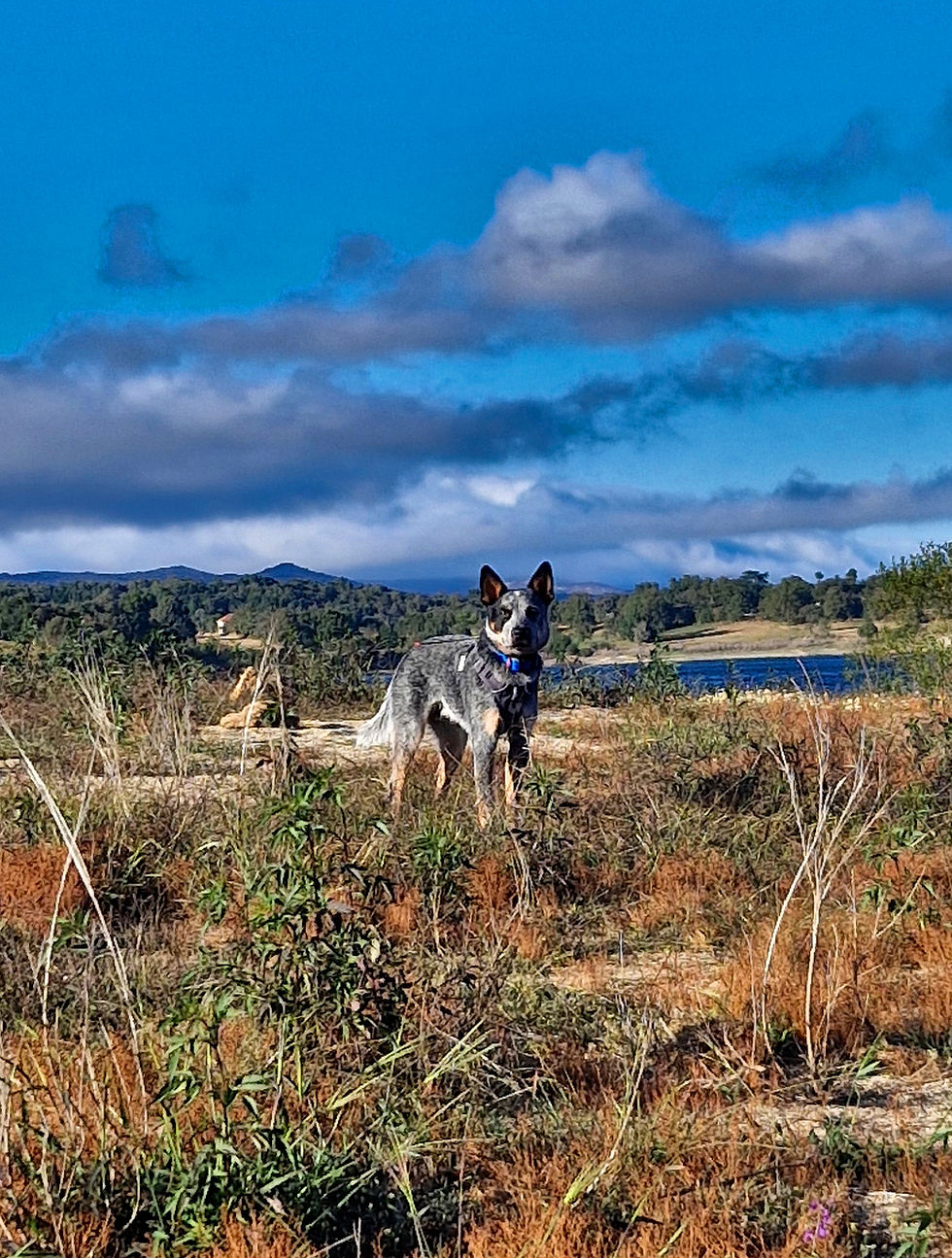
Mrok is a member of our cat, dog and human family. What I see in him is an illustration, not a rule. The ability to reach for different studies and descriptions is what makes Mrok, and any other dog, the most interesting part of living together: watching, and through that, getting to know the dog in the things we do side by side.

References
Australian Cattle Dog Club of America. Working Standard (approved 1996). https://www.acdca.org/working-standard/
Australian Cattle Dog Rescue Association. Living with an ACD. https://www.acdra.org/living-with-an-acd
Weeks, A.R., Kriesner, P., Bartonicek, N., van Rooyen, A., Cairns, K.M., Ahrens, C.W. (2025). Genetic structure and common ancestry expose the dingo-dog hybrid myth. Evolution Letters, 9(1), 1-12. DOI: 10.1093/evlett/qrae057
Sommerlad, S.F., Morton, J.M., Haile-Mariam, M., Johnstone, I., Seddon, J.M., O'Leary, C.A. (2012). Prevalence of congenital hereditary sensorineural deafness in Australian Cattle Dogs and associations with coat characteristics and sex. BMC Veterinary Research, 8: 202. DOI: 10.1186/1746-6148-8-202
Strain, G.M. (2015). The Genetics of Deafness in Domestic Animals. Frontiers in Veterinary Science, 2: 29. DOI: 10.3389/fvets.2015.00029
Strain, G.M. (2004). Deafness prevalence and pigmentation and gender association in dog breeds at risk. The Veterinary Journal, 167(1), 23-32.
Junttila, S., Valros, A., Mäki, K., Väätäjä, H., Reunanen, E., Tiira, K. (2023). Breed differences in social cognition, inhibitory control, and spatial problem-solving ability in the domestic dog (Canis familiaris). Scientific Reports, 12: 22529. DOI: 10.1038/s41598-022-26991-5
Bewick, T. (1790). A General History of Quadrupeds. Newcastle upon Tyne: S. Hodgson, R. Beilby and T. Bewick.
Tench, W. (1789). A Narrative of the Expedition to Botany Bay. London: J. Debrett.
Hammond, N. (2026). The Origins of the Australian Cattle Dog and the Australian Stumpy-Tail Cattle Dog. Kombinalong Kennels (breeder source).
State Library of New South Wales. First Fleet livestock records, 1788. https://www.sl.nsw.gov.au/
Belgenny Farm. The Cowpastures and its Wild Cattle. https://www.belgennyfarm.com.au/history/site-history/the-cowpastures-and-its-wild-cattle
And... the internet, attacking me with countless targeted ads full of "amazing things" about the ACD 😊


Comments